PhD
📌The graduation requirement regulations.
The graduation requirements are also outlined in the curriculum.
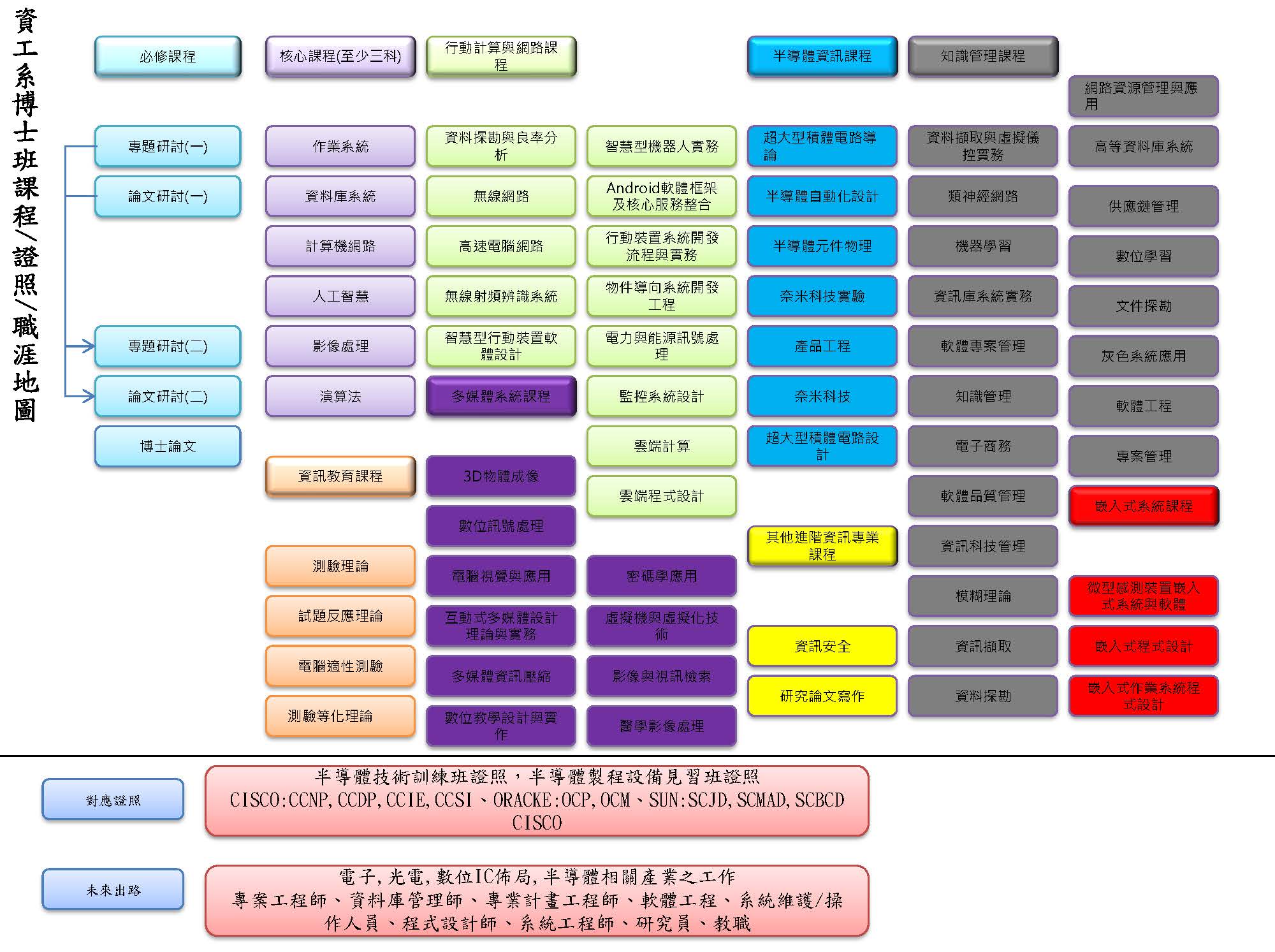
1. The PhD program includes the following six core courses: Algorithm, Database System, Operating System, Computer Network, Imaging Processing, and Artificial Intelligence. Students must pass at least three of these core courses.
2. In addition to completing the required graduation credits, students must pass the qualification exams, graduation qualification review, and PhD degree examination (including PhD dissertation proposal and dissertation review) in order to graduate. Students must pass two qualification exams, with the available subjects being: Algorithm, Database System, Operating System, Computer Network, Imaging Processing, and Artificial Intelligence.
3. Students are required to complete 6 hours of designated courses on the "Taiwan Academic Ethics Education Resource Center" online platform and achieve a passing grade on the final test before they are eligible to apply for the degree examination.
📌Graduation Instructions
-
Doctoral students are required to complete the following compulsory courses, which are classified as mathematics and basic science courses: 6 credits for the doctoral dissertation and 6 credits for thesis seminars, totaling 12 credits. These courses account for more than one-quarter of the minimum graduation requirement of 36 credits. Additionally, students must enroll in a thesis seminar course every semester for the first three years after admission, or complete and pass the thesis seminar course every semester until graduation.
-
Doctoral students are also required to participate in academic conferences for paper presentations. The graduation requirements for the doctoral program include coursework regulations, qualifying examinations, doctoral dissertation proposal defense, and the final dissertation oral defense.
(a)Study Regulations:
In addition to the general requirements (excluding thesis seminar and dissertation research credits, students must complete at least 18 credits), the department has added the following conditions to enhance students' global perspective:
(i) During their studies, students must present a research paper in English at least once at an international conference.
(ii) Before the final dissertation oral defense, students must have at least two papers published or accepted by SCI, SSCI, or EI-indexed journals.
(b) Qualifying Examination:
Students must select two subjects for assessment. Available subjects include: Algorithm, Operating System, Computer Networks, Database System, Artificial Intelligence, Compiler, Computerized Adaptive Testing, Image Processing.
Each subject is graded as either “Pass” or “Fail.”
(c) When a student passes two qualifying subjects, their graduation requirements for publications are: One paper published in an SCI journal (or two papers in EI-indexed journals) and One paper published in an EI-indexed conference.
🔸PhD student manual and schedule link
📌Curriculum Plan Table
| Curriculum Plan for the 2025–2026 Academic Year (Academic Year 114) |  |
| Curriculum Plan for the 2024–2025 Academic Year (Academic Year 113) | |
| Curriculum Plan for the 2023–2024 Academic Year (Academic Year 112) | |
| Curriculum Plan for the 2022–2023 Academic Year (Academic Year 111) | |
| Curriculum Plan for the 2021–2022 Academic Year (Academic Year 110) | |
| Curriculum Plan for the 2020–2021 Academic Year (Academic Year 109) | |
| Curriculum Plan for the 2019–2020 Academic Year (Academic Year 108) | |
| Curriculum Plan for the 2018–2019 Academic Year (Academic Year 107) | |
📌Course Arrangement
Doctoral Program Curriculum Planning Concept: The program is designed to cultivate fundamental research capabilities as its foundation, complemented by advanced core courses and elective courses in information technology to enhance professional knowledge in the field. The goal is for students to acquire solid expertise in information science and develop the ability to independently analyze and solve problems. The program further strengthens doctoral students’ skills in identifying issues, conducting independent analysis, and devising effective solutions.
📌Course Features
The curriculum is centered around two main categories of elective courses: Advanced Core Elective Courses and Advanced Information Elective Courses.
🔸 Advanced Core Elective Courses
To ensure that doctoral graduates possess fundamental proficiency in information science, the program requires students to complete at least two courses from a set of designated advanced core electives.
The doctoral program offers the following eight core courses:Algorithm, Operating System, Computer Networks, Database System, Project Management, Artificial Intelligence, Image Processing, Item Response Theory.
🔸Advanced Information Elective Courses
The advanced information elective courses are divided into six major categories: Mobile Computing and Networking, Knowledge Management, Information Education, Multimedia Systems, Semiconductor Information, Embedded Systems.
Doctoral students may select appropriate professional core courses based on their research field, in consultation with their academic advisor.
📌Learning Map