Interdisciplinary Course Program
✨You can click on the images to jump to the section you want to learn about!
|
|
|
|
|
|
📌Introduction to Cross-Disciplinary Learning
✨Please complete your studies according to the curriculum regulations of each program (check the first three digits of your student ID or ask your department assistant to confirm which year’s regulations apply!)
First, let’s talk about what kinds of “Cross-Disciplinary Learning” we have~
Currently offered “Cross-Disciplinary Learning” programs:
- “Double Major”
- “Minor”
- “Cross-Disciplinary Micro-Program”
- “Cross-Disciplinary Specialty Program”
Second, let’s talk about the advantages of “Cross-Disciplinary Learning”~
We promote “Cross-Disciplinary Learning” to help students:- Gain professional knowledge in their major department while also having the opportunity to extend into another professional field.
- Accumulate two or more professional competencies during their studies, which will be a great asset when facing future career challenges.
- Elevate their added value and make “Cross-Disciplinary Learning” a key to an extraordinary life!!

Note:
According to university regulations, starting from the 2017 academic year, all daytime undergraduate students (except those in certain departments preparing for national examinations) must complete at least one professional program in their major department and one cross-disciplinary learning program (options include “Double Major,” “Minor,” “Cross-Disciplinary Program,” “Cross-Department Specialty Program,” or “Sub-Specialty” (completing three professional courses offered by the department providing the specialty program)), and meet the relevant graduation requirements to be eligible for graduation.
📌Application Instructions
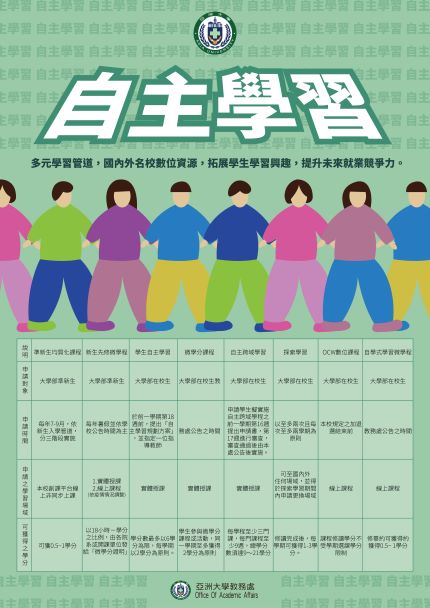
| ✨Cross-Disciplinary Learning Application Instructions✨ | ||||
| Description | Minor | Double Major | Cross-Disciplinary Micro-Program | Cross-Disciplinary Specialty Program |
| (On-campus / CMU) | (On-campus / CMU) | |||
| Application Period | From enrollment, applications are accepted after mid-term exams according to the dates announced by the Office of Academic Affairs. | From the first semester of Year 1 to the first semester of Year 4, applications/changes are accepted during Weeks 13–15 of each semester as announced. | ||
| Application Items | Minor | Double Major | 1. On-campus Cross-Disciplinary Micro-Program 2. Inter-University Cross-Disciplinary Micro-Program |
Disciplinary Specialty Program |
| Study Requirements | At least 20 credits; follow the course regulations of the minor department. | At least 40 credits; follow the course regulations of the double major department. | At least 9 credits; follow the course regulations of each micro-program. |
1. Disciplinary Specialty Program: 12 credits. 2. Sub-Specialty: complete three professional courses offered by the department providing the specialty program. |
| Notation on Diploma upon Completion | 1. On-campus Minor: Noted as “○○ Minor”. 2. CMU Minor: Noted as “China Medical University ○○ Minor”. |
1. On-campus Double Major: Noted as “○○ Double Major”. 2. CMU Double Major: Noted as “China Medical University ○○ Double Major”. |
1. On-campus Cross-Disciplinary Micro-Program: Noted as “Cross-Disciplinary: ○○ Micro-Program”. 2. Inter-University Cross-Disciplinary Micro-Program: Noted as “Completed inter-university cross-disciplinary program with ○○ University: ○○ Micro-Program”. |
1. Disciplinary Specialty Program: Noted as “○○ Disciplinary Specialty Program”. 2. Sub-Specialty: Noted as “○○ Sub-Specialty”. |
📌Double Major
🔸Application Method and Eligibility
All sophomore and junior students in undergraduate programs
Students whose academic performance in the previous semester ranks within the top 50% (inclusive) of their major class and who pass the interview may apply to pursue a double major in this department.
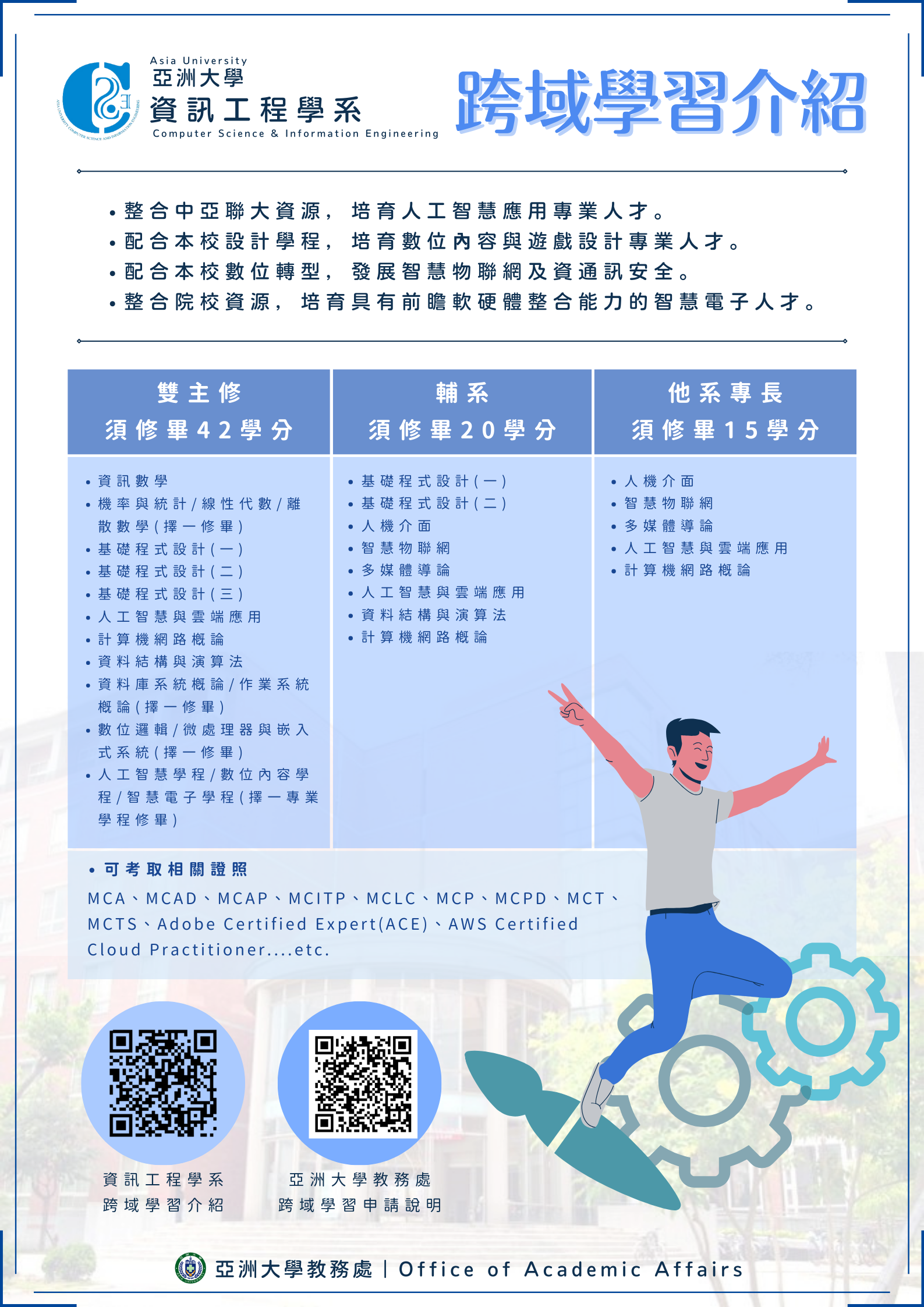
🔸Completion Requirements and Course Plan (24 credits of department core courses + 18 credits of one specialty program = 42 credits)
🔸Explanation of Certifiable Licenses after Completion (related certifiable licenses are listed below)
🔸Implementation Guidelines for Asia University Department of Computer Science and Information Engineering Students Pursuing a Double Major
- These guidelines are formulated in accordance with the university’s “Regulations for Students Pursuing a Double Major in Various Departments.”
- All sophomore and junior undergraduate students whose academic performance in the previous semester ranks within the top 50% (inclusive) of their major class and who pass the interview may apply to pursue this department as their double major.
- Students approved for a double major in this department must complete an additional 24 credits of department core courses and 18 credits of one specialty program, totaling 42 credits, in addition to fulfilling the credit requirements of their original department:
- Other related matters for undergraduate students pursuing a minor shall be handled in accordance with the university’s “Regulations for Students Pursuing a Minor in Various Departments.”
- These guidelines shall be implemented after approval by the department affairs meeting, and the same applies to amendments.
|
Department Core Courses 24 Credits |
Department Specialty Elective Programs 18 Credits (complete one program) |
Certifiable Licenses |
||
|
Artificial Intelligence Program |
Information Security Program |
Semiconductor Information Program |
||
|
- Fundamental Programming - Information Mathematics - Probability and Statistics / Linear Algebra / Discrete Mathematics (choose one) - Artificial Intelligence and Cloud Applications - Introduction to Computer Networks - Data Structures and Algorithms - Introduction to Database Systems / Introduction to Operating Systems (choose one) - Microprocessors and Embedded Systems |
- Data Science - Machine Learning - Deep Learning - Cloud Services - Big Data Processing - Generative AI |
- Introduction to Information Security - Cryptography - Network Attack and Defense Technology - Network Security - Cloud Security - AI-based Network Security |
- Electronics (I) - Electronics Lab (I) - Electronics (II) - Electronics Lab (II) - Circuit Theory - Circuit Theory Lab - Digital System Design - Introduction to Integrated Circuit Design |
- AWS series certifications |
📌Minor
🔸Application Method and Eligibility
• All sophomore and junior undergraduate students
• Students whose academic performance in the previous semester ranks within the top 50% (inclusive) of their major class and who pass the interview may apply to pursue this department as their minor.
🔸Completion Requirements and Course Plan
• Students approved to minor in this department (referred to as minor students) must complete 21 credits of required and elective courses offered by this department in addition to fulfilling their original department’s credit requirements.
🔸Explanation of Certifiable Licenses after Completion (related certifiable licenses are listed below)
🔸Implementation Guidelines for Asia University Department of Computer Science and Information Engineering Students Pursuing a Minor
- These guidelines are formulated in accordance with the university’s “Regulations for Students Pursuing a Minor in Various Departments.”
- All sophomore and junior undergraduate students whose academic performance in the previous semester ranks within the top 50% (inclusive) of their major class and who pass the interview may apply to pursue this department as their minor.
- Students approved to minor in this department must complete 20 credits of required and elective courses offered by this department.
- Other related matters for undergraduate students pursuing a minor shall be handled in accordance with the university’s “Regulations for Students Pursuing a Minor in Various Departments.”
- These guidelines shall be implemented after approval by the department affairs meeting, and the same applies to amendments.
|
Department Core Courses 21 Credits |
Certifiable Licenses |
|
- Fundamental Programming - Artificial Intelligence and Cloud Applications - Introduction to Information Security - Introduction to Computer Networks - Data Structures and Algorithms - Web System Development - Generative AI |
- AWS series certifications |
📌Cross-Disciplinary Micro-Programs
![]() |
![]() |
![]() |
Cross-Disciplinary Program – Cross-Platform APP Programming (This program will be terminated starting from the 114 academic year)
| Leading College | College of Information and Electrical Engineering | Co-organizing Departments | Department of Computer Science and Information Engineering, Department of Mobile Commerce and Multimedia Applications, Department of Information Communication, Department of Bioinformatics and Medical Engineering |
| Convener Name | Hsing-Chung Chen | Convener Title | Distinguished Professor |
| Convener Phone | 48015 | Convener Email | cdma2000@asia.edu.tw |
Program Convener
| Name | Department | Title | Responsibility | Phone | |
| Hsing-Chung Chen | Department of Computer Science and Information Engineering | Distinguished Professor | Overall coordination of cross-disciplinary program planning | 48015 | cdma2000@asia.edu.tw |
Instructors
| Instructor | Title | Course Offered |
| Prof. Chih-Jen Tsai | Professor | iOS APP Programming (Required) |
| Asst. Prof. Wei-Ju Yang | Assistant Professor | Android APP Programming (Required) |
| Adjunct Prof. Shih-Chang Tsao | Adjunct Professor | Cross-Platform APP and Database Integration Development (Required) |
🔸Program Introduction
With the rapid development of information technology, this program is specially designed to cultivate cross-platform APP development skills required for industry-academia collaboration, using Visual Studio to develop professional APPs for iOS/Android/Windows that integrate IoT and databases.
Through this cross-platform APP program, students will receive training in various APP system software programming and further design practical APPs that integrate IoT and database access, cultivating high-level cross-platform APP programming talent needed by industry. In other words, it equips students with the ability to be job-ready upon graduation and nurtures cross-platform APP developers in line with global trends.
🔸Program Features and Advantages
- Cultivate talent to meet industry demand for cross-platform APP programming, reducing the gap between learning and application
- Enhance students’ knowledge in cross-platform APP programming
- Strengthen students’ cross-platform APP development capabilities
- Develop students’ industry-academia application skills related to cross-platform APP programming
- Cultivate high-quality cross-disciplinary talent to increase graduates’ competitiveness
🔸Career Prospects
This program trains students in Web APP development, Android/iOS APP programming, human-computer interface theory, mobile application development practice, cross-platform smart life and IoT integration, and database-integrated APP development. Instructors provide opportunities for internships and visits to related cross-disciplinary enterprises (e.g., Nantex Industry, Cheng Shin Rubber, Pou Chen Group), allowing students to experience real-world needs and strengthen workplace readiness.
🔸Employment Guidance
The Cross-Platform APP Programming Micro-Program enhances the employability of students from the Department of Computer Science and Information Engineering, Artificial Intelligence, Information Communication, Bioinformatics and Medical Engineering, and Photonics and Communication Engineering. In addition to their primary professional skills, the added value of cross-platform APP programming provides students with more diverse high-quality education and expands future career fields related to cross-platform APP development.
Participating Departments: Department of Computer Science and Information Engineering, Department of Artificial Intelligence, Department of Information Communication, Department of Bioinformatics and Medical Engineering
Total Credits: 15 credits Passed by the University Curriculum Committee on April 26, 112
Semiconductor Industry Bridging Micro-Program
🔸Industry and Societal Talent Demand
Taiwan is a global semiconductor hub, with central Taiwan being the core of the packaging and testing industry. Major international companies like Siliconware Precision Industries (SPIL) have continuous and substantial demand for foundational talent possessing “production understanding × digital literacy × basic technological knowledge × team communication skills.” This program targets students without an engineering background, strengthening their foundational electrical knowledge, packaging processes, smart health, data analysis, and AI application literacy to become entry-level talent ready for immediate contribution in the workplace.
🔸Industry Connection Description
This program has signed an MOU with Siliconware Precision Industries Co., Ltd. (SPIL) to jointly promote talent cultivation and workplace internship opportunities. SPIL’s Talent Development Department manager participates in course design and serves as an industry mentor. Courses incorporate problem-based learning (PBL) and company visits, with students able to apply for short-term internships or capstone projects in their senior year to enhance industry understanding and workplace adaptability.
🔸Course Plan
📌Disciplinary Specialty Programs
🔸Application Method and Eligibility
From the second semester of Year 1 to Year 3, applications/changes are accepted during Weeks 13–15 of each semester as announced.
🔸114 Academic Year Disciplinary Specialty Course Plans
|
Artificial Intelligence Technology |
|
|
Semiconductor IC Design |
|
|
Network and Cloud Security |
|
113–109 Academic Year Course Plan (15 credits total) |
Certifiable Licenses after Completion |
|
- Introduction to Information Security (3 credits) |
- AWS series certifications |